
Across industries and technology stacks, many organizations experience a similar pattern as their systems grow.
Early expansion feels productive and exciting. Teams move quickly, infrastructure evolves, and capabilities increase. For a time, this growth looks like momentum.
Then something shifts. Delivery slows. Reliability becomes harder to maintain. Costs rise faster than expected. Teams spend more time stabilizing systems than improving them.
The issue is rarely a single tool or decision. It is the relationship between scale, complexity, and operational control.
The Pattern
As systems grow, complexity increases faster than most organizations anticipate. New services, data flows, dependencies, teams, and delivery expectations all add interaction points.
If architectural maturity, ownership, and governance do not evolve at a similar pace, instability begins to compound. At first, it appears as friction. Over time, it becomes operational drag.
This is what we refer to as the Scaling Instability Curve™: the point where delivery velocity begins to exceed the organization’s ability to manage complexity with confidence.
Diagram
The diagram below illustrates this pattern and the path back toward stability.
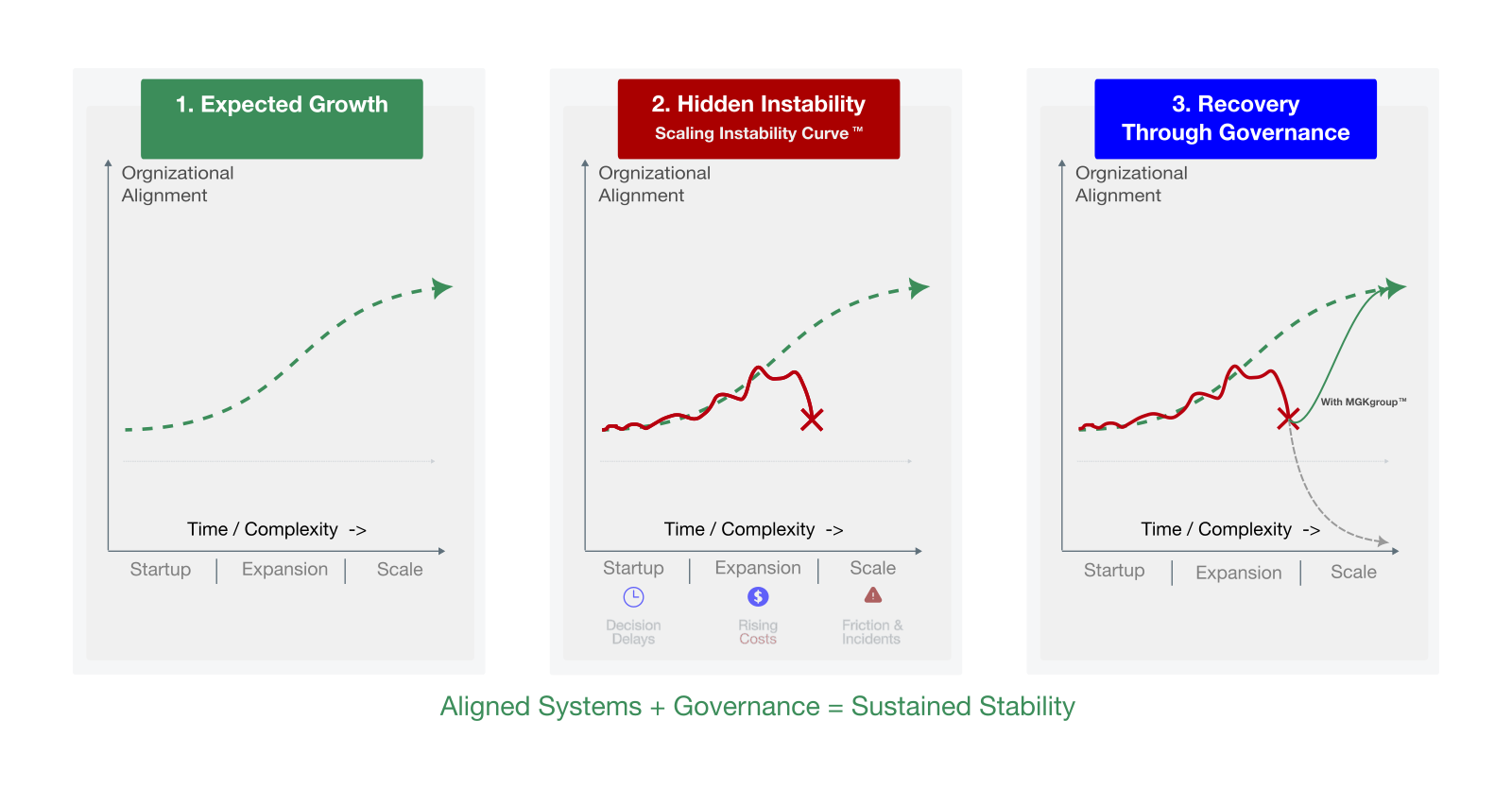
Early Growth
Momentum
Teams move quickly. Features ship. Systems evolve organically. Most tradeoffs still feel manageable.
Expanding Surface Area
More services, integrations, and data dependencies are introduced to support growth and delivery pressure.
Hidden Complexity
Complexity is present, but its operational cost has not yet fully surfaced.
Instability Phase
Delivery Slows
Releases become harder to coordinate. The cost of change increases. Teams spend more time navigating dependencies.
Ownership Blurs
Responsibilities become unclear across systems, teams, and data boundaries. Problems take longer to isolate and resolve.
Operational Drag Increases
Reliability work, incidents, rising cost, and rework begin to consume the attention that should be driving progress.
Stabilization Path
Architectural Clarity
Boundaries are tightened. System responsibilities are made explicit. The platform becomes easier to reason about.
Operational Discipline
Ownership, observability, release practices, and governance mature enough to support continued growth.
Restored Momentum
Teams regain the ability to move predictably because the underlying system is no longer resisting change.
Why Organizations Hit This Phase
Technology systems do not only scale in size. They scale in relationships.
Every new service, dataset, workflow, and integration introduces additional coordination cost. Without clear ownership, defined standards, and architecture that can absorb growth, complexity compounds faster than teams can manage it.
This phase is not a sign that teams are failing. It is often the predictable outcome of growth without corresponding evolution in engineering discipline.
How Organizations Recover
Recovery rarely starts with a dramatic rewrite. More often, it begins by restoring clarity.
The path forward usually includes clearer architectural boundaries, better operational standards, improved ownership, stronger data governance, and a more disciplined approach to how change is introduced.
Once stability returns, delivery speed becomes sustainable again — not because the organization slowed down, but because it regained control.
Where MGKgroup Fits
MGKgroup is often brought in when organizations recognize that something has shifted, but the root cause is not yet clear.
Our work focuses on reducing operational drag, restoring clarity, and helping teams move from reactive firefighting back to disciplined engineering.
If systems have become harder to change, costs are rising without clear explanation, or delivery is slowing under growing complexity, it may be time to step back and evaluate where you are on the curve.
Read the Outside Perspective
In TNW, journalist Callum Turner explores Greg Keith’s Scaling Instability Curve and what can happen when technology and delivery scale faster than an organization’s governance.
Read “The detrimental cost of scaling too fast” on TNW (opens in a new tab).
Get the Executive Brief
Take the Scaling Instability Curve Executive Brief into your next leadership conversation. Read it alongside the pattern described here, then connect with Kiara to discuss your organization’s needs.
Download the Executive Brief (PDF, 358 KB)
For the experience behind the framework, read the Founder’s Perspective.
Does This Pattern Sound Familiar?
If growing complexity is slowing delivery or making reliability harder to maintain, a conversation can help clarify where to begin. Kiara Palmer, Business Development Manager, connects you with the appropriate MGKgroup expertise.
The Scaling Instability Curve is not a marketing framework. It is a pattern we have seen repeatedly in real systems, under real constraints, where the cost of instability is measured in outages, delays, and lost confidence.